Lead Quality Over Lead Volume: The Metric Shift That Changes Everything
A thousand leads that never answer the phone cost more than a hundred that do. How to rebuild campaigns around qualified conversations instead of form fills.
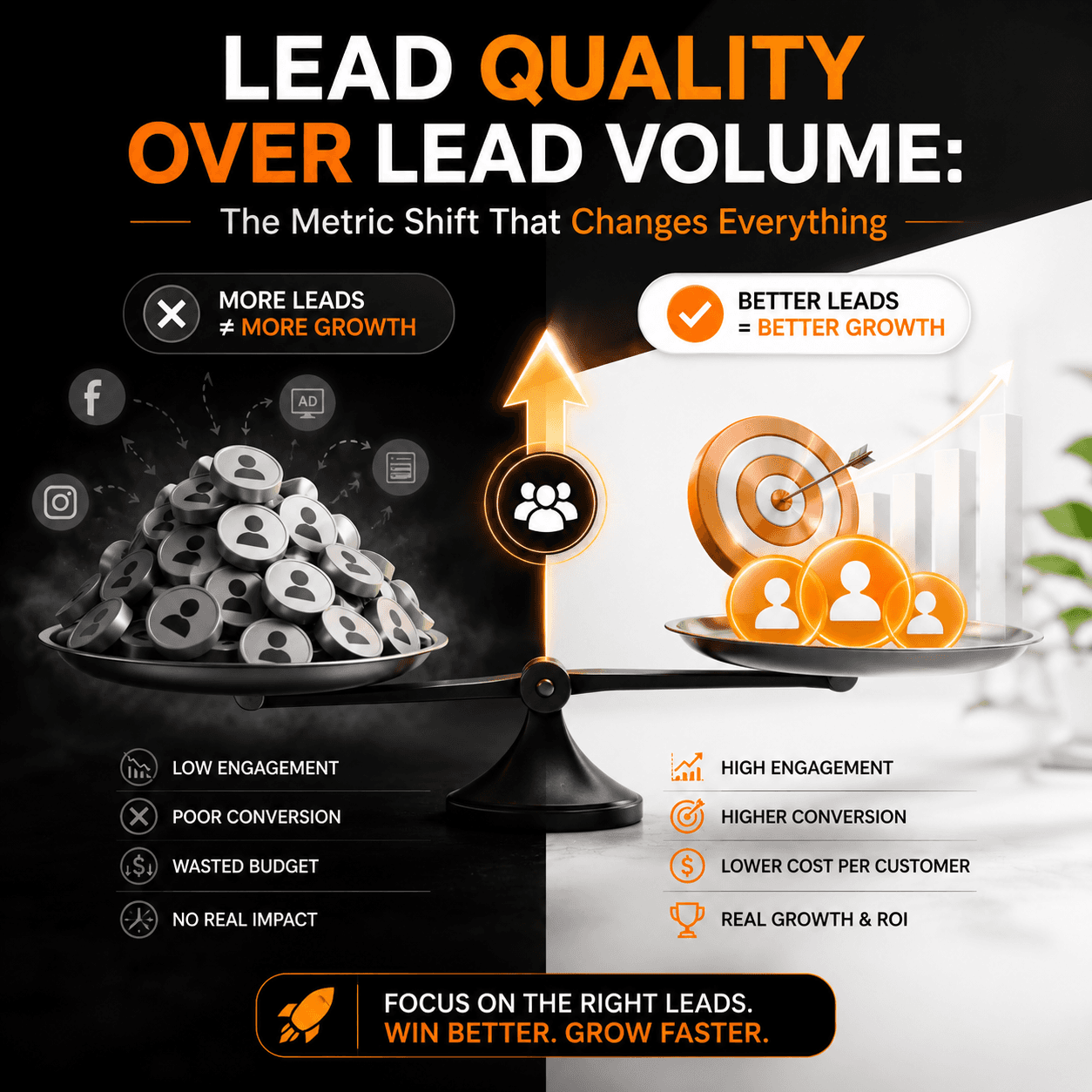
Cost per lead is the most reassuring bad metric in marketing. It always improves when you ask it to. Widen the targeting, soften the form, add a discount hook — the number falls, the dashboard turns green, and the sales team quietly stops trusting marketing.
The problem is not that CPL is wrong. It is that CPL is a cost metric being used as a quality metric, and those move in opposite directions more often than anyone admits.
The arithmetic nobody runs
Two campaigns, same monthly spend. Campaign A produces 500 leads at a low CPL. Campaign B produces 120 at four times the CPL. On the dashboard, A wins decisively.
Now add the two columns nobody puts on the dashboard: what share of each set answers the phone, and what share of those closes. When A's leads connect at 20% and close at 5%, and B's connect at 65% and close at 18%, B produces roughly three times the customers for the same money — and it looked like the loser all quarter.
There is also a cost that never appears anywhere: your sales team's hours. Four hundred unqualified leads is not free — it is a week of somebody's month spent being ignored, plus the morale cost of a pipeline that mostly does not answer.
Why platforms drift toward volume
Not malice — instruction. If you hand Google or Meta a 'lead' conversion that fires on form submit, you have told the algorithm that all form submits are equally valuable. It will then do exactly what you asked, extremely well: find you the cheapest people who will fill in a form. Cheap form-fillers are not the same population as buyers.
The algorithm is not the problem. The definition you gave it is.
Rebuilding around qualified conversations
Move the conversion event down the funnel
Stop optimising to form submit. Optimise to the first event that correlates with revenue — a held sales call, a qualified status in the CRM, a completed application. Send that event back to the platform with offline conversion imports or the conversions API. This single change does more for lead quality than any targeting adjustment.
- Qualified lead — meets your basic fit criteria (budget, geography, category). The minimum viable upgrade over raw form fills.
- Connected conversation — someone actually spoke to them. Strong signal, arrives within days.
- Closed revenue with value — the real target. Best signal, but slow; use it once volume supports it.
Add friction on purpose
Every field you remove raises volume and lowers intent. That trade is sometimes right — and it is a trade, not a free win. Adding budget range, timeline, or a required phone number will cut your lead count and raise your customer count. Do it deliberately, and measure it at the customer line, not the lead line.
Let the copy disqualify
Ads that state price bands, minimum engagement size, or who this is not for will lose you clicks you were going to lose anyway — after you paid for them. Pre-qualifying in the ad is the cheapest filter available.
Feed the negative signal back
Junk leads are training data. Push your disqualified list back as an exclusion audience and let the platform learn the shape of a bad lead, not just the shape of a good one. Most accounts do the first half of this and never the second.
The metric to put on the wall
Replace cost per lead with cost per qualified conversation, and review it by source. It is harder to calculate, it moves slower, and it will occasionally make a campaign you like look bad. That is precisely why it is worth having.
Volume is what you report when you cannot yet measure quality. Once you can, nobody asks about volume again.

Sushant Rana
Business Growth Consultant. 8+ years building revenue systems across India, the USA, Canada and Australia.